Bangladesh came to today's shape through a long history of political evolution. Bengal was probably the wealthiest part of the subcontinent up till the 16th century. The area's early history featured a succession of Indian empires, internal squabbling, and a tussle between Hinduism and Buddhism for dominance. All of this was just a prelude to the unstoppable tide of Islam which washed over northern India at the end of the 12th century. Mohammed Bakhtiar Khalzhi from Turkistan captured Bengal in 1199 with only 20 men.
Under the Mughal viceroys, art and literature flourished, overland trade expanded and Bengal was opened to world maritime trade - the latter marking the death knell of Mughal power as Europeans began to establish themselves in the region. The Portuguese arrived as early as the 15th century but were ousted in 1633 by local opposition. The East India Company negotiated terms to establish a fortified trading post in Calcutta in 1690.
 The decline of Mughal power led to greater provincial autonomy, heralding the rise of the independent dynasty of the nawabs of Bengal. Humble East India Company clerk Robert Clive ended up effectively ruling Bengal when one of the impetuous nawabs attacked the thriving British enclave in Calcutta and stuffed those unlucky enough not to escape in an underground cellar. Clive retook Calcutta a year later and the British Government replaced the East India Company following the Indian Mutiny in 1857.
The Britons established an organizational and social structure unparalleled in Bengal, and Calcutta became one of the most important centers for commerce, education and culture in the subcontinent. However, many Bangladeshi historians blame the British dictatorial agricultural policies and promotion of the semi-feudal zamindar system for draining the region of its wealth and damaging its social fabric. The British presence was a relief to the minority Hindus but a catastrophe for the Muslims. The Hindus cooperated with the Brits, entering British educational institutions and studying the English language, but the Muslims refused to cooperate, and rioted whenever crops failed or another local product was rendered unprofitable by government policy.
At the closure of World War II it was clear that European colonialism had run its course and Indian independence was inevitable. Independence was attained in 1947 but the struggle was bitter and divisive, especially in Bengal where the fight for self-government was complicated by internal religious conflict. The British, realizing any agreement between the Muslims and Hindus was impossible, decided to partition the subcontinent. That Bengal and Punjab, the two overwhelmingly Muslim regions, lay on opposite sides of India was only one stumbling block. The situation was complicated in Bengal where the major cash crop, jute, was produced in the Muslim-dominated east, but processed and shipped from the Hindu-dominated city of Calcutta in the west.

Inequalities between the two regions i.e. East and West Pakistan soon stirred up a sense of Bengali nationalism that had not been reckoned with during the push for Muslim independence. When the Pakistan government declared that `Urdu and only Urdu' would be the national language, the Bangla-speaking Bengalis decided it was time to assert their cultural identity. The drive to reinstate the Bangla language metamorphosed into a push for self-government and when the Awami League, a nationalistic party, won a majority in the 1971 national elections, the president of Pakistan, faced with this unacceptable result, postponed opening the National Assembly. Riots and strikes broke out in East Pakistan, the independent state of Bangladesh was unilaterally announced, and Pakistan sent troops to quell the rebellion.
The ensuing war was one of the shortest and bloodiest of modern times, with the Pakistan army occupying all major towns, using napalm against villages, and slaughtering and raping villagers. Bangladeshis refer to Pakistan's brutal tactics as attempted genocide. Border clashes between Pakistan and India increased as Indian-trained Bangladeshi guerrillas crossed the border. When the Pakistani air force made a pre-emptive attack on Indian forces, open warfare ensued. Indian troops crossed the border and the Pakistani army found itself being attacked from the east by the Indian army, the north and east by guerrillas and from all quarters by the civilian population. In 11 days it was all over and Bangladesh, the world's 139th country, officially came into existence. Sheikh Mujib, one of the founders of the Awami League, became the country's first prime minister in January 1972 ; he was assassinated in 1975 during a period of crisis
The ruined and decimated new country experienced famine in 1973-74, followed by martial law, successive military coups and political assassinations. In 1979, Bangladesh began a short-lived experiment with democracy led by the overwhelmingly popular President Zia, who established good relationships with the West and the oil-rich Islamic countries. His assassination in 1981 ultimately returned the country to a military government that periodically made vague announcements that elections would be held `soon'. While these announcements were rapturously greeted by the local press as proof that Bangladesh was indeed a democracy, nothing came of them until 1991. That year the military dictator General Ershad was forced to resign by an unprecedented popular movement led by the Bangladesh Nationalist Party and the Awami League.
Democracy was re-established and the economy ticked along at a 4.5% growth rate, which hardly made it an 'Asian tiger' but was at least respectable. Political dog-fighting between the BNP and the Awami League became acrimonious in the run up to national elections in February 1996 leaving the country strike-ridden and rudderless. The election was marred by violence and boycotted by the three main opposition parties, resulting in a BNP shoo-in. However, low voter turnout and reports of ballot-box stuffing by polling officials raised serious questions about the government's legitimacy and in April 1996 Prime Minister Begum Khaleda agreed to stand down and appointed an interim caretaker administration, pending new elections scheduled for 12 June 1996.In the elections Awami League got the largest number of seats. Sheikh Hasina Wazed, the leader of the Awami League, was sworn in as the Prime Minister of Bangladesh Government.
##################Official NameThe People's Republic Of Bangladesh
CapitalDhaka (Area 414 sq. km. Master plan 777 sq.km.)CurrencyCurrency unit is Taka. Notes are of 1,2,5,10,20,50,100 and 500 Taka. Coins are of 1,5,10,25,50 and 100 Poisha (100 Poisha = 1 Taka)
LanguageBangla is the state language. English is also widely spoken and understood. Arabic is read and spoken for religious purposes
PopulationTotal estimated population 130 million.
ReligionsMuslim 88.3%, Hindu 10.5%, others 1.2%
AreaTotal: 144,000 sq km
Land: 133,910 sq km
Water: 10,090 sq km
LocationLatitude from 20 degree 34' to 26 degree 38' north. Longitude from 88 degree 01' to 92 degree 41' east.
BoundaryBounded by India from the north, east and west, Burma from the south-east and the Bay of Bengal from the south .
ClimateTropical; cool, dry winter (October to March); hot, humid summer (March to June); cool, rainy monsoon (June to October)
RainfallLowest 47" and highest 136"
National DaysNational Martyrs Day ( February 21)Independence Day ( March 26 )Victory Day ( December 16)
Principal RiversPadma, Meghna, Jamuna, Brahmaputra, Madhumati, Surma and Kushiara
Principal CropsRice, jute, tobacco, tea, sugarcane, vegetables, potato, pulses, etc.
FruitsMango, banana, pineapple, jack-fruit, water-melon, green coconut, guava, lichis, etc.
Major IndustriesJute, sugar, paper, textiles, fertilizers, cigarette, cement, steel, natural gas, oil-refinery, newsprint, power generation, rayon, matches, fishing and food processing, leather, soap, carpet, timber, ship-building, telephone, etc.
AirportsZia International Airport, Dhaka,Chittagong International Airport,Sylhet International Airportand domestic airports at Jessore, Sylhet, Cox's Bazar, Rajshahi and Saidpur
<!-- START OF Link Building Experts: Internet Marketing Company -->
<a href="http://linkbuildingexperts.co.uk/"><img src="http://linkbuildingexperts.co.uk/link-building-done.gif" ALT="Search engine optimization company"></a><br>
<a href="http://linkbuildingexperts.co.uk/link-building-services.html" target="_blank"><b>Link building company</b></a>
<!-- END OF Link Building Experts: Internet Marketing Company -->
##########################Sea PortsChittagongMongla
Tourist InterestsLongest sea beach, colorful tribal life, centuries' old archeological sites, the Sundarbans (home of the Royal Bengal Tigers and spotted deer), largest tea gardens, interesting riverine life, etc.
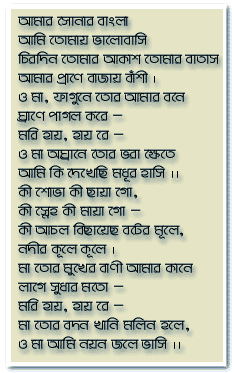
National Anthem of Bangladesh
Forever your skies, your air set my heart in tune
as if it were a flute,
In Spring, Oh mother mine, the fragrance from
your mango-groves makes me wild with joy-
Ah, what a thrill!
In Autumn, Oh mother mine,
in the full-blossomed paddy fields,
I have seen spread all over - sweet smiles!
Ah, what a beauty, what shades, what an affection
and what a tenderness!
What a quilt have you spread at the feet of
banyan trees and along the banks of rivers!
Oh mother mine, words from your lips are like
Nectar to my ears!
Ah, what a thrill!
If sadness, Oh mother mine, casts a gloom on your face,
my eyes are filled with tears!